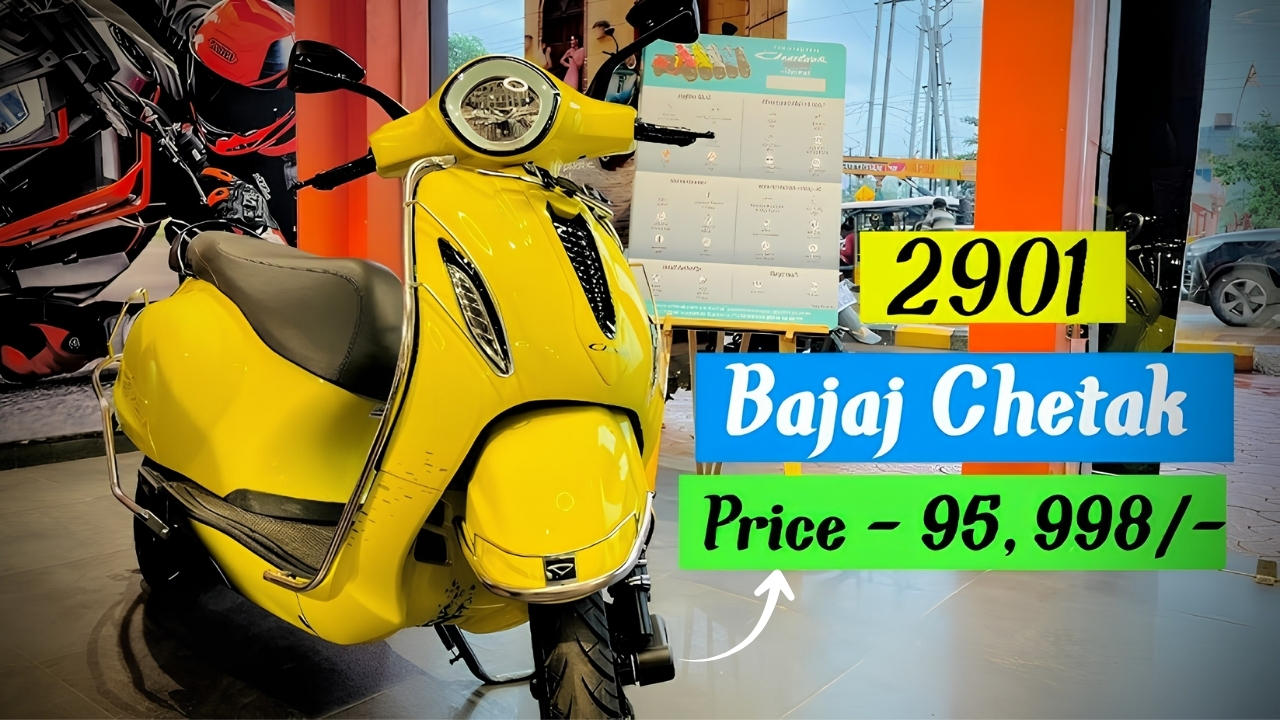
Bajaj Chetak EV : In the bustling streets of Indian cities, where traffic snarls and fuel prices often dictate daily commutes, the Bajaj Chetak EV has emerged as a beacon of practical, eco-friendly mobility.
By mid-2026, this iconic electric scooter has not only crossed the 8-lakh cumulative sales mark but also evolved into a family of models tailored for diverse rider needs.
From budget-conscious buyers to tech-savvy urbanites, the Chetak lineup now offers something for everyone, blending Bajaj’s legacy of reliability with cutting-edge electric innovation.bikedekho+1
A Legacy Reborn: The Chetak’s Electric Journey
The Chetak name carries decades of nostalgia for Indian two-wheeler enthusiasts. Originally launched as a petrol scooter in the 1970s, it became a household symbol of durability and style.
When Bajaj Auto revived it as an electric scooter in January 2020, the brand signaled its commitment to India’s EV revolution. Fast-forward to 2026, and the Chetak EV has become one of the country’s best-selling electric scooters, with over 34,000 units sold in April 2026 alone.bikedekho+1
This resurgence isn’t just about nostalgia. Bajaj has restructured the Chetak family into three clear series—C25, C30, and C35—replacing the older 2900-series naming.
Each series targets a specific segment, from entry-level commuters to performance-oriented riders, ensuring the Chetak remains relevant in a crowded EV market.
C25 Series: The Budget-Friendly Urban Companion
Launched in January 2026, the Chetak C2501 is the most affordable model in the lineup, priced at ₹91,399 (ex-showroom). It’s designed for city dwellers who prioritize efficiency and ease of use.
With a 2.5 kWh NMC battery, the C2501 offers a claimed range of 113 km on a full charge, making it ideal for daily commutes and short errands.timesnownews+1
The C2501’s lightweight design (107 kg) and 60 km/h top speed ensure nimble handling in tight urban spaces. It comes in six vibrant colors—Sea Blue, Yellow, Grey, Red, Black, and White—allowing riders to express their personality.
While it lacks some premium features, the C2501 includes Eco and Sport riding modes, hill-hold assist, and a 750W off-board charger that fully charges the battery in 4 hours.timesnownews+1
C30 Series: The Balanced All-Rounder
The C3001 sits in the middle of the Chetak family, offering a blend of performance and practicality. Priced at ₹1,11,006 (ex-showroom, Delhi, July 2026), it features a 3.0 kWh battery with a certified range of 127 km.
Its top speed of 70 km/h and improved 0–80% charging time of 2 hours 55 minutes make it a versatile choice for both city and highway riding.
Standard features on the C3001 include Eco and Sport modes, hill-hold assist, and a refined design that enhances aerodynamics.
The scooter’s metal body and durable build quality reflect Bajaj’s commitment to longevity, while its compact footprint ensures easy parking in crowded areas.bikedekho+1
C35 Series: The Tech-Loaded Flagship
At the top of the Chetak pyramid sits the C35 series, comprising the C3501, C3502, and C3503 variants. The flagship C3501, priced at ₹1,39,000 (ex-showroom), is a tech enthusiast’s dream. It boasts a 3.5 kWh battery, a certified range of 153 km, and a top speed of 80 km/h, powered by a 4.8 kW motor.drivespark+1
The C3501’s standout feature is its Google Maps integration, accessible via the Chetak smartphone app. Riders can enjoy real-time navigation, turn-by-turn directions, and OTA (over-the-air) updates that keep the scooter’s software current without visiting a service center.
The C3502 and C3503 variants offer similar performance but with varying feature sets, such as turn-by-turn navigation on the C3502 and a more basic setup on the C3503.bikedekho+1
Performance and Practicality: What Makes the Chetak Stand Out
The 2026 Chetak EV lineup isn’t just about numbers—it’s about real-world usability. Bajaj has increased top speeds across all variants, with the C2501 reaching 60 km/h, the C3001 and C3503 hitting 70 km/h, and the C3501 and C3502 cruising at 80 km/h. This performance boost addresses one of the common criticisms of earlier EVs: limited speed for highway commuting.
Charging convenience has also improved. The C3001’s 0–80% charging time has dropped from 3 hours 50 minutes to 2 hours 55 minutes, while the C35 series maintains a 3-hour 25-minute window.
For daily commuters, this means less downtime and more time on the road. The inclusion of a portable fast charger in the C30 series further enhances convenience, allowing riders to charge at home or work without relying on public infrastructure.drivespark+1
Bajaj has also focused on ride quality. The Chetak’s metal body, combined with a well-tuned suspension system, ensures a smooth ride even on uneven Indian roads.
Hill-hold assist, now standard from the C30 series upward, prevents rollback on inclines—a feature that’s particularly useful in hilly cities like Pune or Shimla.drivespark+1
Design and Customization: Style Meets Substance
The 2026 Chetak EVs retain the neo-retro design language that has become a hallmark of the brand. Sleek lines, a rounded front apron, and LED lighting give the scooter a modern yet timeless appeal.
Bajaj has introduced 11 color options across the lineup, including the new C25’s six vibrant shades, allowing riders to choose a hue that matches their personality.
For those who want to personalize their ride, Bajaj launched an accessories list in 2026, offering customization options like colored body panels, storage solutions, and comfort upgrades.
While these accessories come at an additional cost, they enable riders to tailor their Chetak to their specific needs, whether it’s for daily commuting or weekend getaways.
Market Impact and Future Plans
The Chetak’s success has had a ripple effect on India’s EV market. With 8 lakh cumulative sales by June 2026, Bajaj has proven that electric scooters can be both affordable and desirable.
The brand’s export plans—covering 100 countries, including Nepal, Sri Lanka, and the Philippines—highlight its global ambitions.
Looking ahead, Bajaj Auto has announced plans to launch electric motorcycles by fiscal 2028, further expanding its EV portfolio.
The company is also ramping up Chetak production capacity to 60,000 units per month, ensuring it can meet growing demand both domestically and internationally.reuters+1
Why the Chetak EV Matters for India’s EV Revolution
The Bajaj Chetak EV is more than just a scooter—it’s a symbol of India’s transition to sustainable mobility. By offering a range of models at different price points, Bajaj has made electric commuting accessible to a wider audience.
The Chetak’s blend of performance, technology, and practicality addresses the key concerns of Indian riders: range anxiety, charging time, and build quality.bikedekho+1
As cities grapple with pollution and fuel prices, the Chetak EV offers a viable alternative. Its metal body, long-range battery, and smart features make it a compelling choice for anyone looking to switch to electric.
With Bajaj’s commitment to innovation and expansion, the Chetak is poised to remain a leader in India’s EV revolution for years to come.reuters+1
Final Thoughts: The Chetak’s Road Ahead
The 2026 Bajaj Chetak EV lineup represents a significant leap forward for electric mobility in India. From the budget-friendly C2501 to the tech-loaded C3501, each model caters to a specific segment of riders, ensuring the Chetak remains relevant in a competitive market.
Also Read this – 2026 Subaru Forester powerful 650HP engine, luxury features with ambient lights
With its blend of performance, style, and practicality, the Chetak is not just a scooter—it’s a statement of intent for a cleaner, greener future.bikedekho+1
As Bajaj continues to expand its EV portfolio and production capacity, the Chetak’s legacy is set to grow. For now, it stands as a testament to what’s possible when tradition meets innovation—a scooter that honors its past while powering India’s electric future.